
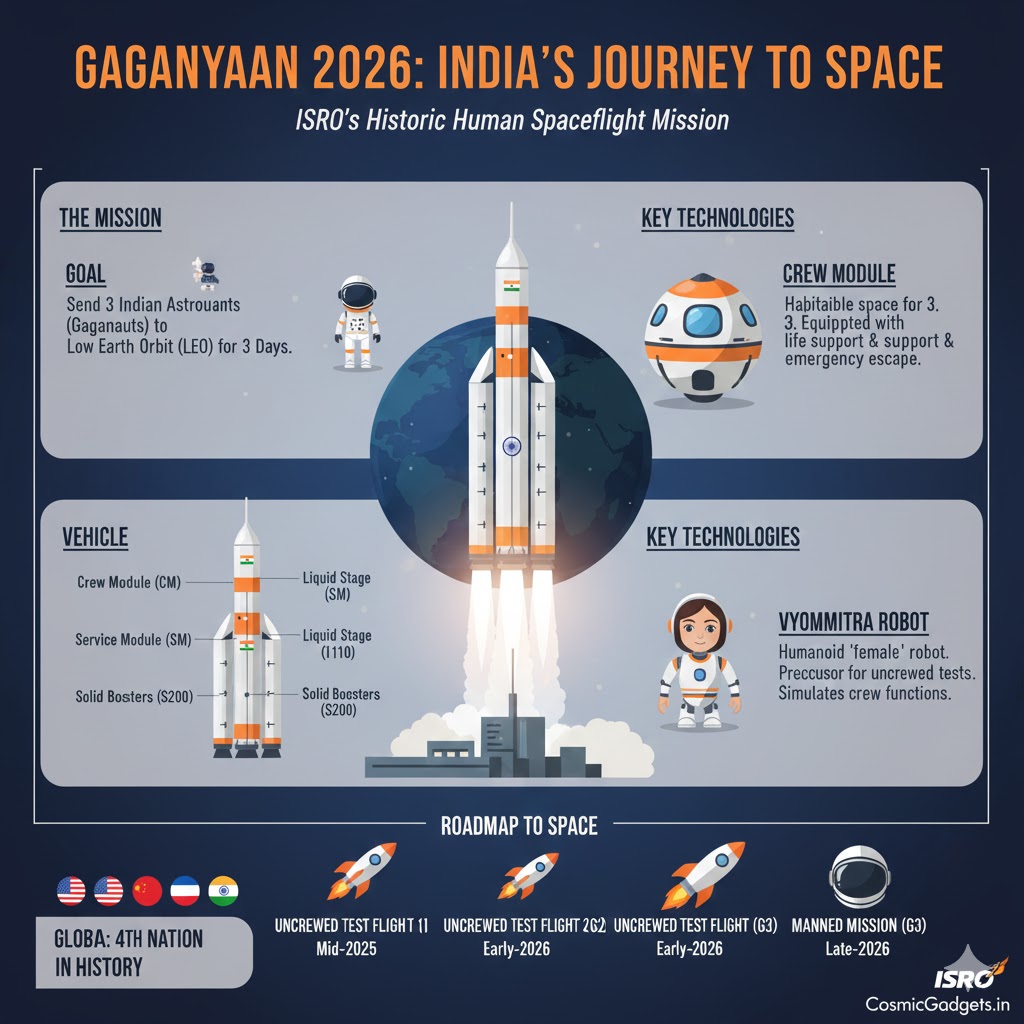
India is preparing for a historic leap into human spaceflight. Gaganyaan, the Indian Space Research Organisation’s (ISRO) flagship human spaceflight program, is expected to send Indian astronauts into space by 2026, making India the fourth nation in history to independently launch humans into orbit — after the USA, Russia, and China.
This mission is not just about reaching space; it represents India’s arrival as a major space power.
🌍 What Is Gaganyaan 2026 Mission?
Gaganyaan (meaning “Sky Vehicle” in Sanskrit) is ISRO’s first human spaceflight mission.
Mission Goals – Gaganyaan 2026:
- 👨🚀 Send Indian astronauts (Vyomnauts) to Low Earth Orbit (LEO)
- 🛰️ Orbit Earth at ~400 km altitude
- ⏱️ Mission duration: ~3 days
- 🏠 Safely bring the crew back to Earth
If successful, India will become the 4th country ever to achieve independent human spaceflight capability.
🧑🚀 Who Are the Gaganyaan Astronauts?
ISRO has selected four Indian Air Force test pilots as astronaut candidates:
- Group Captain Prasanth Balakrishnan Nair
- Group Captain Ajit Krishnan
- Group Captain Angad Pratap
- Wing Commander Shubhanshu Shukla
They are trained extensively in:
- Spaceflight systems
- Microgravity survival
- Emergency procedures
- Zero-G and centrifuge training
Their training is ongoing and includes collaboration with international space agencies.
🛰️ The Technology Behind Gaganyaan 2026
🚀 Launch Vehicle: LVM3 (Gaganyaan 2026)
- India’s most powerful rocket
- Human-rated with enhanced safety systems
- Capable of lifting crew module safely into orbit
🧰 Crew Module
- Pressurized spacecraft for astronauts
- Equipped with:
- Life support systems
- Environmental controls
- Communication & navigation
- Emergency escape system
🪂 Crew Escape System
One of the most critical components:
- Automatically pulls astronauts away if rocket fails
- Successfully tested multiple times by ISRO
🧪 Tests Before the Final Mission
ISRO is taking a step-by-step approach to ensure safety.
Before human launch:
✔ Abort tests
✔ Crew module recovery tests
✔ Uncrewed test flights
✔ Life-support system validation
✔ Parachute landing trials
Only after all tests are successful will astronauts fly.
📅 Why 2026 Is Important
Originally planned earlier, Gaganyaan’s timeline shifted due to:
- COVID-19 disruptions
- Emphasis on astronaut safety
- Additional testing requirements
Now, 2026 is the realistic and carefully planned target — prioritizing safety over speed.
🌏 Why Gaganyaan Is a Big Deal for India
Strategic Importance
- Strengthens India’s position in space diplomacy
- Reduces dependence on foreign launch systems
🧠 Technological Growth
- Boosts R&D in robotics, AI, materials science
- Advances life-support and human-spaceflight tech
💼 Economic & Industrial Impact
- Encourages private space startups
- Creates jobs in aerospace & engineering
- Supports “Make in India” space manufacturing
🌌 How Gaganyaan Compares Globally
| Country | Human Spaceflight |
|---|---|
| USA | ✔ Since 1961 |
| Russia (USSR) | ✔ Since 1961 |
| China | ✔ Since 2003 |
| India | 🚀 Expected in 2026 |
India’s achievement will be especially notable because it is doing this with a fraction of the budget used by other nations.
🔮 What Comes After Gaganyaan 2026 ?
ISRO’s long-term vision includes:
- 🛰️ Bharatiya Antariksha Station (Indian Space Station)
- 🌕 Human missions to the Moon
- 🤝 International space collaboration
- 🧑🚀 Regular astronaut missions
Gaganyaan is just the beginning.
🌟 Final Thoughts
Gaganyaan 2026 is more than a mission — it is a moment of national pride, scientific excellence, and technological confidence.
When Indian astronauts orbit Earth under the tricolor flag, it will mark:
🇮🇳 India’s official entry into the elite club of human spaceflight nations.
The countdown has begun 🚀