
The mystery of how the universe formed from nothing has fascinated scientists for decades. Many physicists believe the universe may have originated from a state of “nothingness” through events like the Big Bang and cosmic inflation.
The origin of the universe is one of the most fascinating mysteries in science. Humans have always wondered: How did the universe begin? And even more puzzling — what existed before the universe itself?
Scientists have been searching for answers to these questions for decades. While we still don’t have a complete explanation, several scientific discoveries and theories provide clues about how our universe may have formed.
Let’s explore the most important ideas scientists have proposed so far.
Edwin Hubble and the Discovery of an Expanding Universe

In the early 20th century, astronomer Edwin Hubble made a discovery that completely changed our understanding of the universe.
Using a telescope at Mount Wilson Observatory in California, Hubble studied distant objects in the sky. At that time, many scientists believed these objects were just clouds of gas inside our galaxy.
However, Hubble discovered something surprising.
These objects were actually entire galaxies, and there were billions of them scattered throughout space.
Even more importantly, Hubble noticed something else:
➡️ The galaxies were moving away from each other.
This observation led to a groundbreaking conclusion:
👉 The universe is expanding.
If the universe is expanding today, then it must have been much smaller in the past. By tracing this expansion backward in time, scientists concluded that the universe must have had a beginning.
The Big Bang Theory: The Birth of Everything
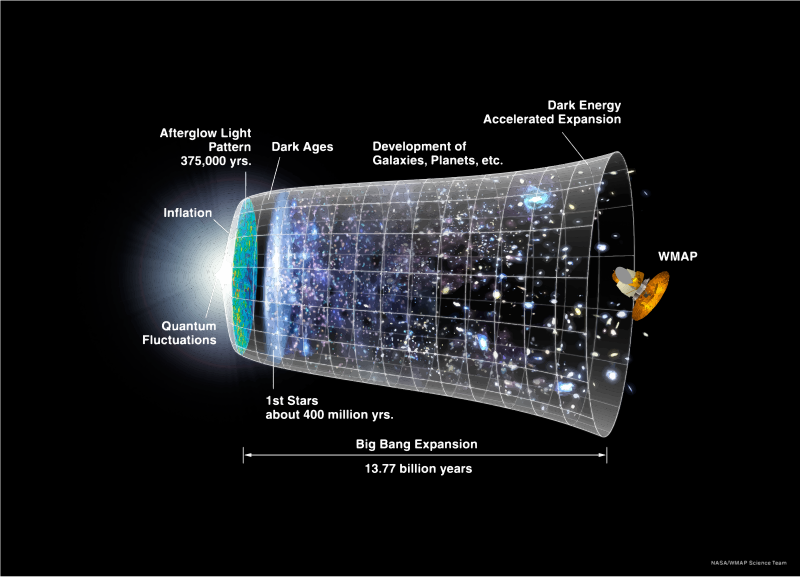
To explain the beginning of the universe, scientists developed the Big Bang Theory.
According to this theory, everything in the universe once existed in a state called a cosmic singularity.
This singularity was:
- Extremely small
- Incredibly dense
- Extremely hot
Imagine compressing the entire universe into a tiny ball smaller than an atom.
Inside this tiny point, pressure and temperature were unimaginably high. Eventually, the energy could no longer remain contained.
Then something extraordinary happened.
💥 The Big Bang occurred.
This was not an explosion in space — it was the expansion of space itself.
The Big Bang created:
- Space
- Time
- Matter
- Energy
- The fundamental forces of nature
Tiny particles called quarks formed first. These particles later combined to create atoms, molecules, stars, and galaxies.
Scientists estimate that this event occurred around 13.8 billion years ago.
Cosmic Inflation: Alan Guth’s Discovery
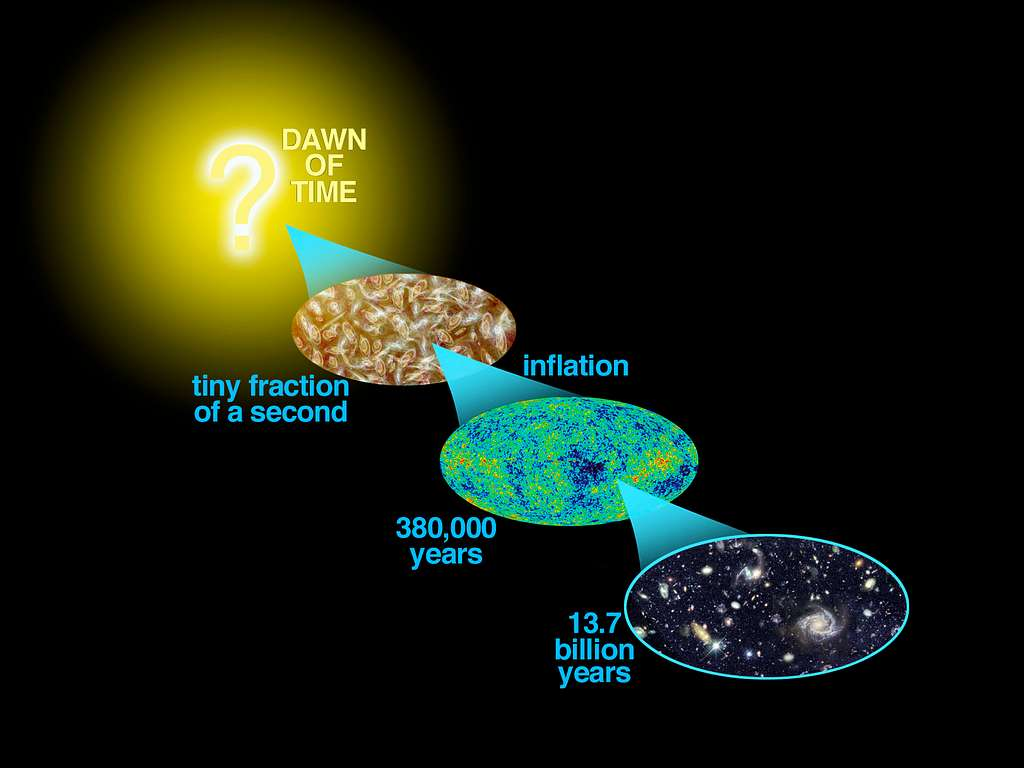
Although the Big Bang explained how the universe began expanding, it left some unanswered questions.
One of the biggest mysteries was this:
The early universe appeared extremely uniform.
Matter was evenly distributed across space, which seemed unlikely if the universe had simply exploded outward.
Physicist Alan Guth proposed a solution known as Cosmic Inflation.
According to Guth’s theory, the universe went through a period of extremely rapid expansion immediately after the Big Bang.
During this tiny fraction of a second, space expanded faster than the speed of light.
This rapid inflation smoothed out the universe, spreading matter evenly across space.
Today, the inflation theory is widely accepted by many scientists.
Quantum Time and the Cyclic Universe
Some scientists believe the Big Bang may not have been the true beginning.
Physicist Martin Bojowald proposed a fascinating alternative idea.
He suggested that time might not flow smoothly as we normally imagine. Instead, time could exist in small discrete segments, similar to the ticking of a clock.
According to this theory, the universe may follow a cyclic pattern:
1️⃣ The universe expands
2️⃣ Eventually it begins to contract
3️⃣ It collapses into a dense singularity
4️⃣ A new Big Bang occurs
This means the beginning of our universe might actually be the end of a previous universe.
In this model, countless universes may have existed before ours — and many more may exist in the future.
Parallel Universes and the Multiverse
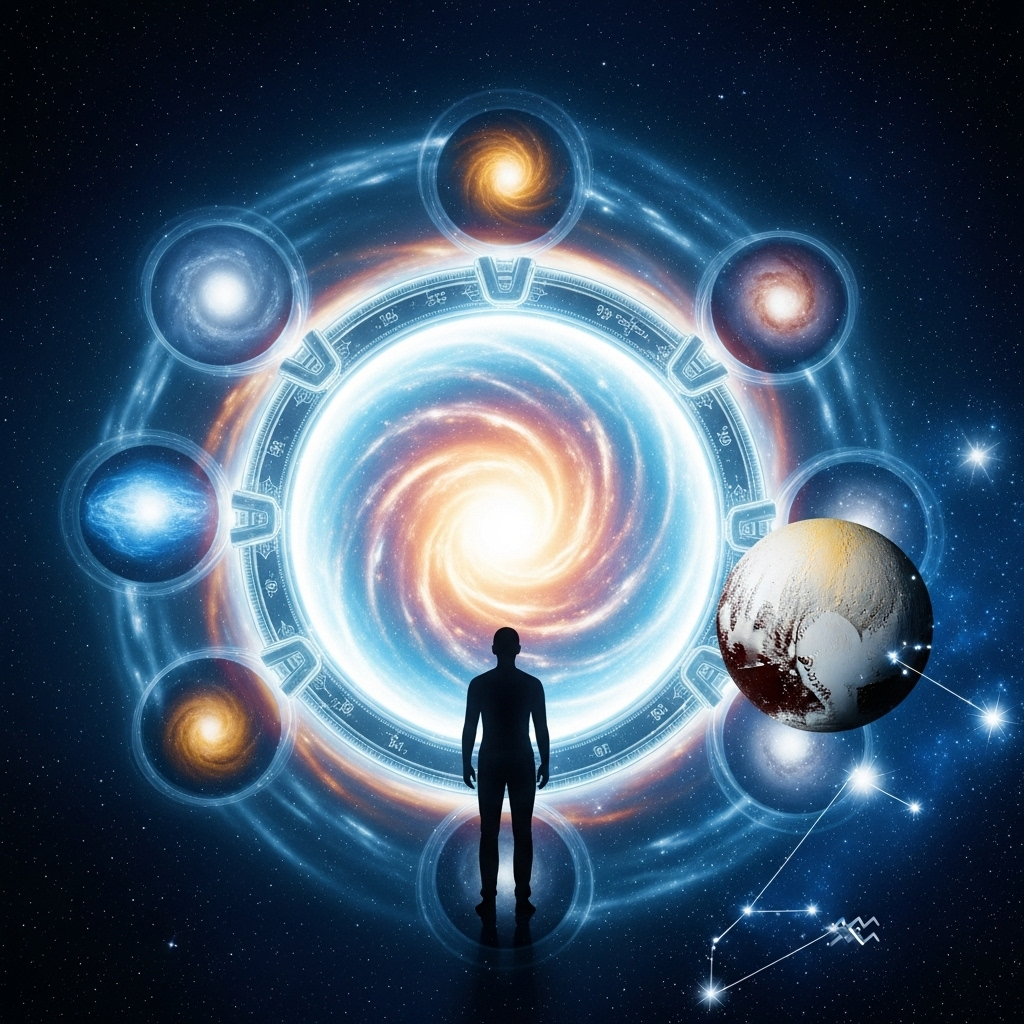
Another fascinating idea comes from physicists Neil Turok and Paul Steinhardt.
They propose that ours might be part of a much larger system known as the multiverse.
In this theory, many universes exist side by side in higher-dimensional space.
These universes are located on structures called “branes” (short for membranes).
You can imagine them like flexible sheets floating in a higher-dimensional space.
Our universe exists on one of these branes.
Brane Collisions: How Universes May Be Created
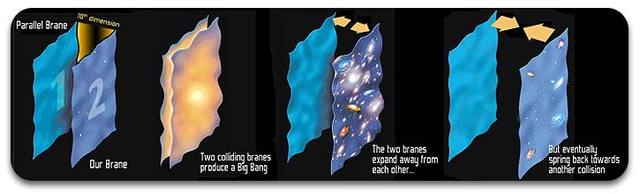
According to the brane collision theory, universes can form when two branes collide.
These branes slowly move toward each other over time.
When they finally collide:
💥 Enormous energy is released.
This collision can trigger an event similar to the Big Bang, creating new universes.
After the collision, the universes move apart and continue evolving.
Eventually, they may collide again — creating another cycle of universes.
This theory is closely connected to string theory and M-theory, which attempt to explain the fundamental structure of reality.
Why We Still Don’t Know the Full Answer
Despite these fascinating ideas, scientists still don’t know exactly how it began.
The main challenge is that:
- We cannot directly observe events before the Big Bang
- The physics of singularities is not fully understood
- Some theories require extra dimensions that are difficult to test
Because of these limitations, many current theories remain hypotheses rather than proven facts.
The Greatest Mystery in Science
The question “Who created nothing?” may sound philosophical, but it is also one of the deepest scientific questions ever asked.
Did the universe truly emerge from nothing?
Was there a previous universe before ours?
Or are we part of an infinite multiverse?
For now, scientists can only theorize.
But as technology improves and our understanding of physics grows, humanity may one day discover the true origin .
Until then, the mystery of how everything began remains one of the most fascinating puzzles in science.